
“Explain It Again”: How AI Helped Me Pass CIS-DF
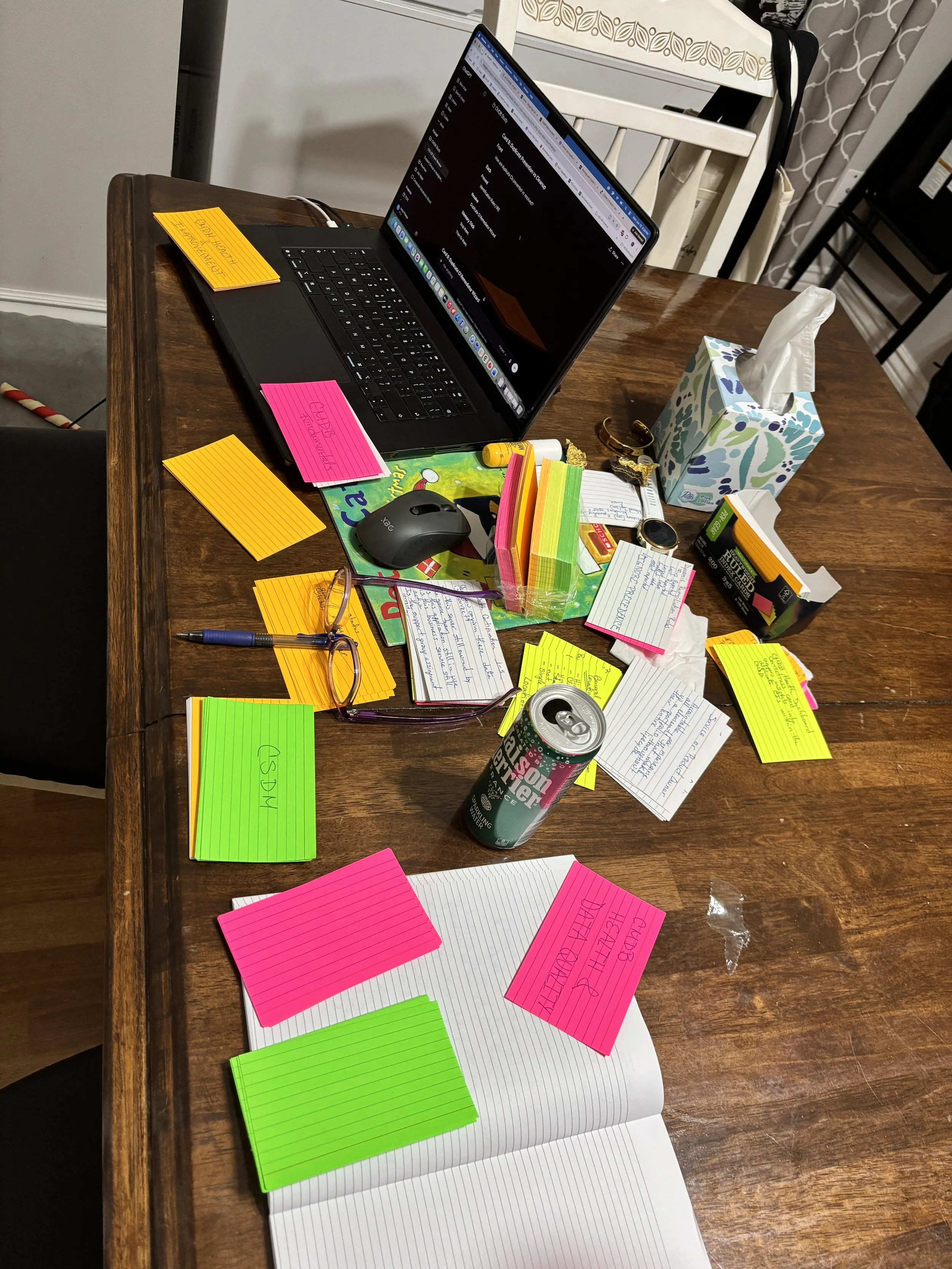
Learning materials for CIS-DF
When I decided to study for the ServiceNow CIS-DF certification, I did what any responsible certification candidate does. I registered and took the required courses on ServiceNow University as suggested. I watched the videos, read the material, rewatched the training. And then I stared at it all…maybe too much information all at once? Maybe not enough hands-on experience in this area? Oh yeah, did I mention that I have never worked on the CMDB space, yeah, all of this was like being in grad school once again. I remember talking to a colleague about it and mentioning that it was more difficult than my capstone for my MIS degree.
Business Capability. Business Service. Service Offering. Business Application. Application Service. Completeness. Correctness. Compliance.
Okay…those are all words, but the truth is that they were meaningless when I read them. The problem was that reading the definitions over and over from my index cards was not necessarily helping me understand how everything actually fit together. I could memorize that this thing relates to that thing, but I knew myself well enough to know that memorization was probably not going to survive contact with an actual exam question.
So I decided to try something different. I turned AI into my personal CIS-DF tutor. And apparently, I am the kind of student who raises her hand constantly during class and challenges the responses given. I put my index cards, notebook, and pen next to me and drilled AI in each topic I was struggling with (which was everything).
"Explain It Again, But This Time for a Complete Beginner"
One of the things I quickly discovered about studying with AI is that you do not have to accept the first explanation. If something did not make sense, I said so.
"Nope. I still do not understand."
Then I would ask another question.
"What is the difference between a Business Application and an Application Service?"
Then another.
"Okay, but why?"
And occasionally:
"That still makes absolutely no sense to me. Explain it as if I am 5 years old"
There was no embarrassed nodding while pretending I understood. There was also no instructor getting tired of me asking the same question for the fifth time. AI would just try again. That turned out to be incredibly helpful. And this was perhaps the most helpful part about AI, I could go back and ask the same question and it would cover it again, and again.
Then We Built a University
The biggest breakthrough with CSDM came when I started asking for examples using something I already understood extremely well: higher education.
I spent many years working in higher education. I understand universities. I understand registration, students, academic departments, Banner, and all the strange machinery required to get a student successfully registered for a class. So instead of trying to understand CSDM through generic examples, we built a university.
Suddenly:
Business Capability: Student Enrollment
Business Service: Student Registration Service
Service Offering: Add/Drop Course Request
Business Application: Banner
Application Service: Banner Production
And I went:
OH.
There it was! Banner was not just another mysterious box floating around a CSDM diagram anymore. I knew what Banner was. I knew what Student Registration was. I could picture the relationships. We kept building on that same example. If I learned a new CSDM object, I wanted to know where it would live in my imaginary university. Eventually, CSDM stopped feeling like a collection of tables I needed to memorize and started feeling like a model I could actually navigate.
Sometimes the Concept Wasn't New. The Name Was.
This was another big realization. Some of my confusion was not because I did not understand the concept. I had just never heard it called that before.
Application Service was a perfect example.
I knew what Banner was. I had worked around Banner for years. I understood that there was the Banner application and that there were actual environments or instances of Banner running.
But if you had walked up to me and said:
"Tell me about the Application Service supporting this Business Application."
I probably would have stared at you.
Because nobody in my higher education world was walking around asking, "How is the Application Service doing today?"
We would say Banner, just Banner. Which we all knew it was most likely Prod instance. Once AI helped me connect the ServiceNow terminology to something I already knew, it clicked:
Banner = Business Application
Banner Production = Application Service
OH.
I already knew what this was. I just did not know ServiceNow had a name for it. That happened over and over while I studied CSDM. Sometimes I would spend quite a while trying to understand a definition, only to finally get an example and realize:
"Wait. THAT is what we are talking about? I know what that is!"
That changed the way I asked questions.
Instead of only asking, "What is an Application Service?" I started asking:
"What would we have called this at a university?"
"Give me an example using Banner."
"What is the thing I already know that corresponds to this CSDM term?"
For me, that translation layer was huge! I was not learning everything from scratch. In many cases, I was attaching new ServiceNow vocabulary to concepts I had already understood for years. Once the terminology had somewhere familiar to land in my brain, it was much easier to remember.
And Then There Was CMDB...
CSDM was only part of the exam. I also needed to understand the CMDB, including CMDB Health, identification and reconciliation, relationships, data quality, and how ServiceNow determines whether the information in the CMDB can actually be trusted. This required a slightly different approach. One example was the CMDB Health Dashboard.
There are three major health KPIs:
Completeness. Correctness. Compliance.
Three C's.
Because apparently one confusing C-word was not enough. Instead of trying to memorize definitions, I started asking:
"What is ServiceNow actually checking?"
That made it much easier.
Completeness: Do we have the information we said we need?
If a CI is supposed to have certain recommended or required fields populated, are they populated?
Correctness: Is this CI actually behaving like a healthy CI?
Are there duplicates? Are there orphan CIs? Are there stale CIs?
Compliance: Does the CI conform to the rules and standards we established for it?
Once I could explain each one in normal language, the terminology became much easier to remember. And then, of course, I would make AI quiz me.
"Give me a scenario and make me decide whether this is Completeness, Correctness, or Compliance."
Getting one wrong was actually useful because then I could ask:
"Why isn't that Correctness?"
That conversation was usually much more valuable than simply being told the right answer.
CSDM and CMDB Finally Became One Story
This was probably one of the most important things I learned while studying. At first, I had CSDM sitting in one mental bucket and CMDB sitting in another. CSDM over here. CMDB over there. Please do not make them interact because I am still trying to figure out what an Application Service is. But eventually, the relationship between them started to make sense.
CSDM provides a standardized model for how service-related information should be represented and related within the platform. The CMDB contains the configuration data and relationships that allow us to understand the actual environment supporting those services.
And those two things absolutely affect each other. You can have a beautifully documented CSDM model on paper, but if the underlying CMDB data is incomplete, duplicated, stale, incorrectly related, or generally having a bad day, your service model is not going to tell you very much. Likewise, having thousands of perfectly discovered CIs does not automatically give you a meaningful service model. You need structure and trustworthy data. That connection helped me stop thinking about CIS-DF as two separate subjects. It was really one bigger story about creating trustworthy data and using that data to understand how technology supports the business.
I Also Argued With My AI Tutor
Another thing that helped was not assuming AI was always right. There were times when I would push back:
"Wait. Yesterday you told me something different."
Or:
"Why would that be the answer instead of this?"
Or most often:
"Are you sure?"
That forced us deeper into the material.
Instead of asking, "What is the correct answer?" I started asking, "Why is that the correct answer?"
That distinction mattered a lot.
If I got a practice question wrong, I did not just want the correct letter. I wanted to know why my answer was wrong, why the other answer was better, and what clue in the question should have pointed me in the right direction. Sometimes we would stay on one tiny concept for quite a while. Probably longer than any reasonable human instructor would have wanted to. Fortunately, AI has nowhere else to be.
Somewhere Along the Way, I Stopped Memorizing
This was probably the biggest surprise. As I got closer to the exam, I realized I was not trying to memorize nearly as much as I normally would for a certification. I was reasoning through things. For CSDM, I had my university. For CMDB, I had scenarios.
If a CI was missing required information, I could reason my way toward Completeness.
If I saw duplicates, stale CIs, or orphans, I could think about Correctness.
If the question was about whether CIs followed established standards, I knew we were talking about Compliance.
And if a question crossed CSDM and CMDB, I could think about the bigger picture:
What are we modeling, what data supports it, and can we trust that data?
That was much more useful to me than trying to remember a sentence I had read three weeks earlier.
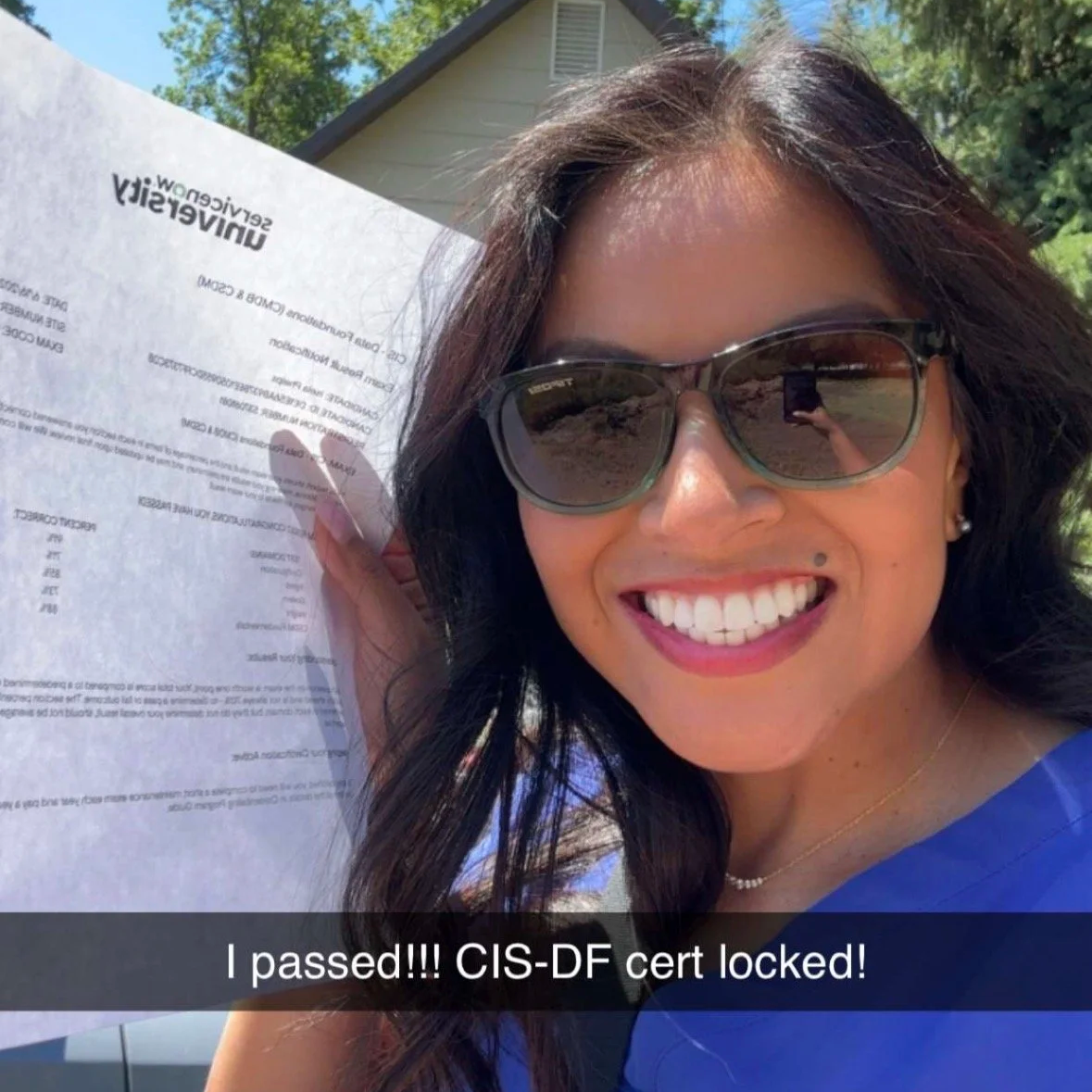
And all of that work paid off. I passed!!!
I was terrified going into the exam. Seventy-five questions in a proctored environment. But I knew I had prepared as much as I possibly could. About 30 minutes later, I was done and staring at the screen, waiting for my results.
It actually took me a second to see the word “Passed.”
I did not really care about my individual scores, although they were not too shabby. I just wanted to pass. And I did.
All those afternoons and weekends of studying paid off!
So apparently my slightly obsessive, ask-AI-67-follow-up-questions-until-it-finally-clicks study method worked.
What I Would Recommend to Someone Studying for CIS-DF
I do not think the lesson here is simply, "Use AI to study for certifications." It is how you use it. Do not just ask AI for answers. Make it teach you.
Give it the exam blueprint and use that to guide what you study. Take one subject at a time. Ask questions. Ask for scenarios. Ask it to quiz you. When you get something wrong, do not immediately move to the next question. Figure out why you got it wrong, and talk to your AI and explain why you chose the selection you did. It surprisingly talks back and pinpoints why your brain went that direction.
Most importantly, connect the material to something you already understand. For me, that was higher education. For you, it might be healthcare, banking, retail, manufacturing, government, or the questionable collection of technology running your own organization.
Whatever it is, make the concepts live somewhere familiar to you. And if the explanation still does not make sense, ask again. And again. And again. AI does not get annoyed. Trust me on this! I tested this extensively and it still talks to me :). After almost a full month of studying every weekend together, I learned something about myself too….that I would love one day to become a CMDB administrator, maybe under the tutelage of a Senior member so I can actually put all this learning to good use.