Beyond the Power Point…
In my last article, I wrote about the OCM blind spot I did not know I had. After years of building technology solutions, I thought I understood what successful implementation looked like. Moving into Change Readiness showed me there was an entire side of transformation I had been missing.
So, I thought I would keep pulling on that thread.
Because as I have learned more about OCM, I have also realized I had some pretty big misconceptions about what it actually was. And I have a feeling I am not the only one.
The Biggest Misunderstanding About Organizational Change Management
We have probably all experienced a technology change that seemed to simply appear one day. Here is your new system. Here is the link. Good luck!
I remember one very clearly.
At a previous organization, we completely changed how employees submitted vacation leave, sick leave, and other time-off requests. We went from filling out a paper form with carbon copies (yes, I am that old!) to using an entirely new online system.
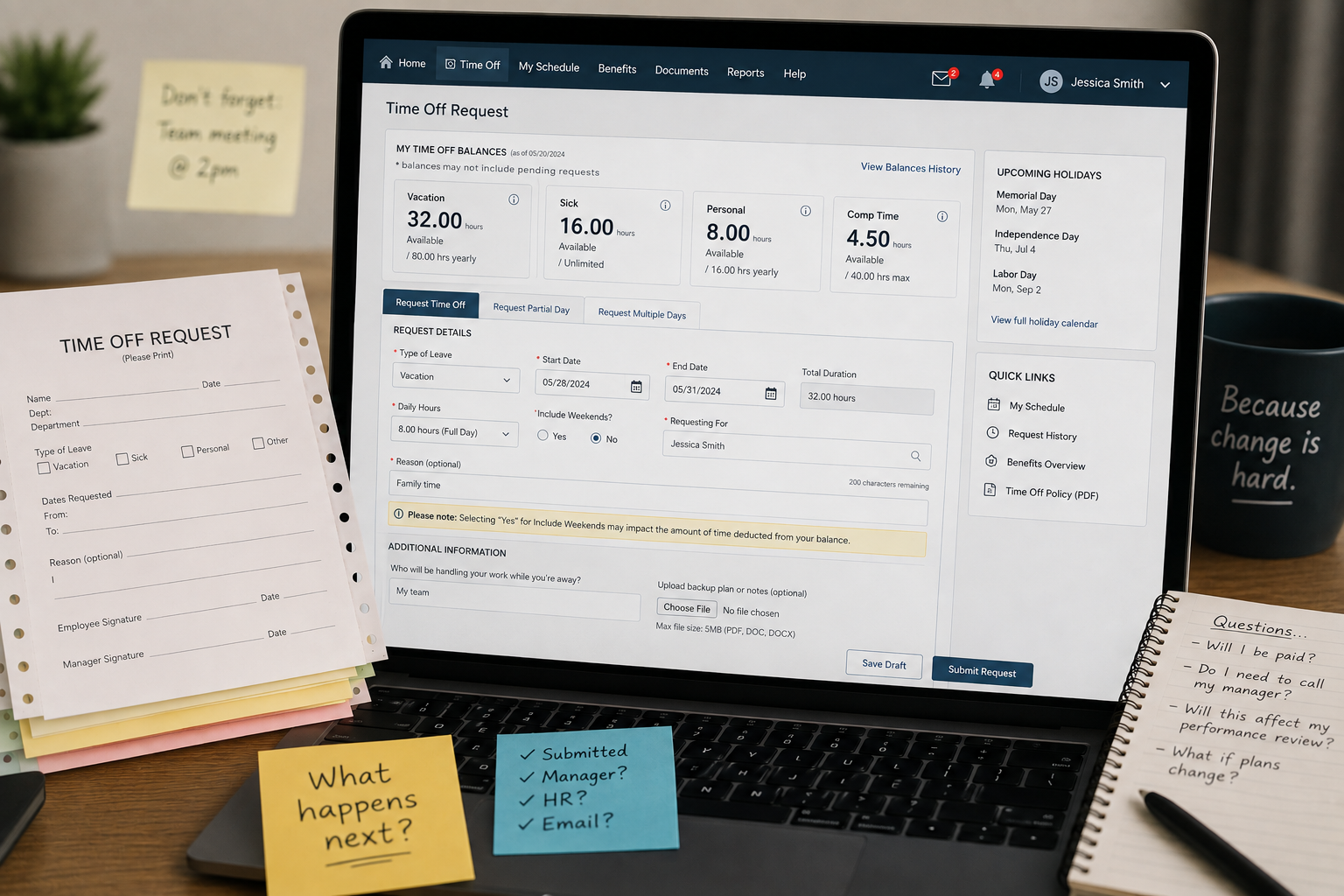
I happened to return from FMLA after the new system had been implemented. When I needed to submit my leave, I was essentially given a link and told to fill it out. That was it! No training, no article to read, no advance notice that something was changing, only a link.
To be fair, the system was not particularly difficult to use. And if an interface is intuitive, does everyone really need an hour-long training session to learn how to submit a form? Probably not.
But sometimes we need a little more than instructions on where to click.Sometimes we need a heads-up that something is changing. Sometimes we need to understand why. And sometimes we simply need the opportunity to have our voices heard. Even when every suggestion cannot be implemented, being asked matters. It tells us that the people designing the change have considered the people who will actually have to live with it.
But back to my leave request.
I figured out the form, filled it out, and clicked Submit. And then...Nothing!
Where did it go? Who had it? Did my manager need to approve it? Was it sitting in someone's queue? Would I receive a notification? Was I done?
I had absolutely no idea!
“Technically, the implementation worked. The system was live. The form worked. I successfully submitted my request.
But was I successfully prepared for the change? Not really.”
And that is where OCM comes in clutch.
At the time, I did not know anything about Organizational Change Management. I certainly did not sit at my desk thinking, "You know what this implementation needs? A better change readiness strategy."
I just knew something was missing.
Now, many years later, I finally have a name for it.
So, What Does OCM Actually Do?
Ironically, now that I work in Organizational Change Management, I have discovered there is another misunderstanding about OCM itself.
Mention OCM during a project meeting, and chances are someone will ask:
"Can you put together a PowerPoint?"
"Can you draft an email?"
"Can you write a knowledge article?"
"Can you create a Quick Reference Guide?"
None of those questions are wrong. They are simply incomplete.
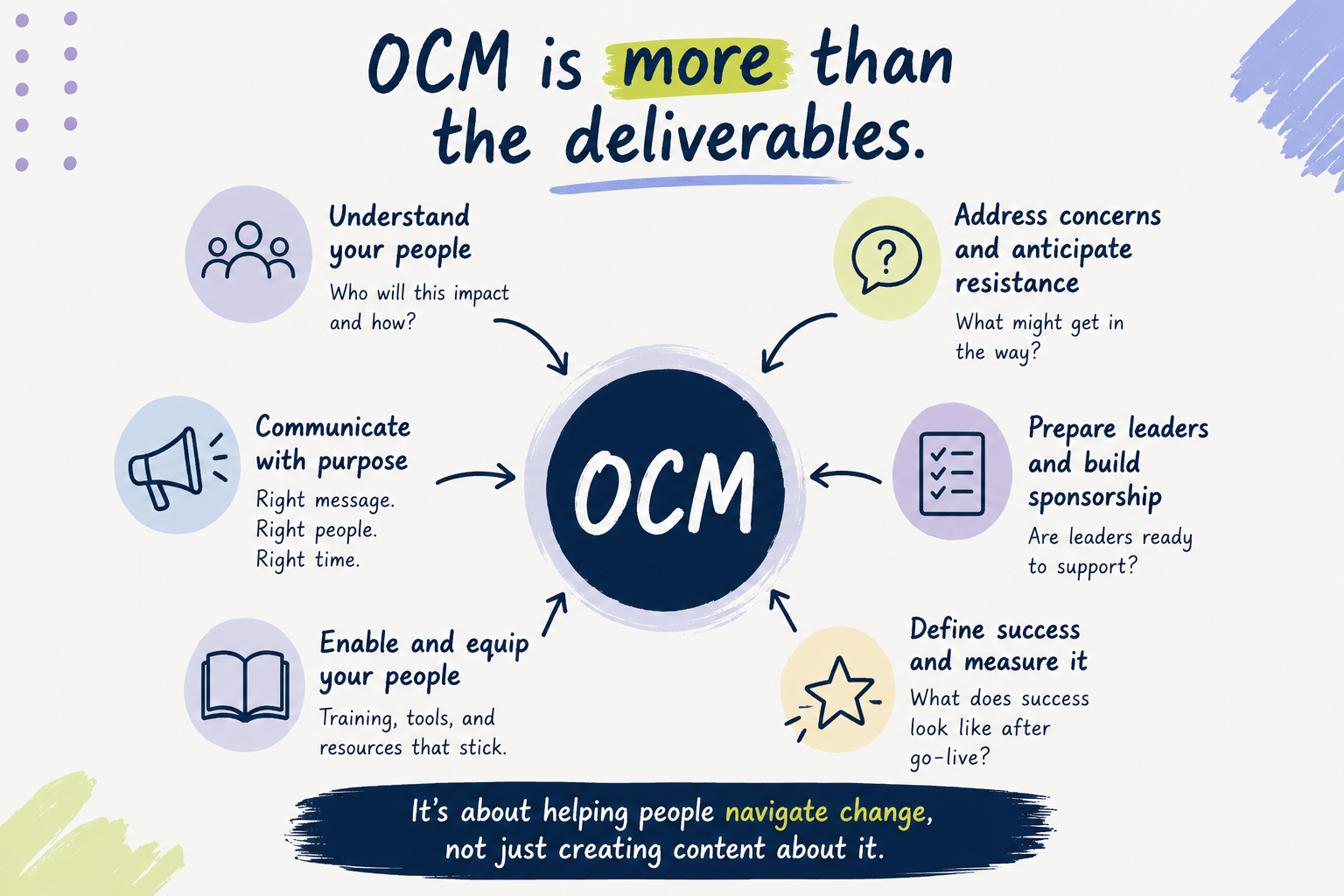
For years, I thought about OCM in much the same way. Finish development. Complete testing. Write the documentation. Send the communication. And, if the bandwidth existed, deliver some training.
Then, magically, everyone would adopt the new process, and the world would be aligned on its axis once again.
Unfortunately, that is not reality.
Those presentations, emails, FAQs, training guides, and knowledge articles are important, but they are the outputs of a much larger effort.
The real work starts earlier. Ideally, while the transformation itself is being envisioned.
Who will this impact? How will their work change? What concerns might they have? Are leaders prepared to support the change? What do people need to be successful after go-live?
That is the heart of OCM. The real reason for its existance.
OCM Is Not a Content Factory
This might be one of the biggest misconceptions I have encountered in this role.
“OCM is not a group of content creators sitting around waiting for someone to say, ‘We need an email!’”
Can we write the email? Absolutely.
But someone has to share with us what needs to be communicated.
Can we create the knowledge article? Yes.
But someone has to explain how the process actually works end-to-end.
Can we develop training? Of course.
But we need to know what we are training people to do.
Developers understand how the solution works. Business analysts understand the requirements. Process owners understand the future-state process. Subject matter experts understand the operational details.
OCM takes that expertise and helps translate it for the people experiencing the change.
We think about what they need to know, what might confuse them, what matters to them, and how to communicate it in a way that makes sense.
“The best outcomes happen when those roles collaborate, each bringing their expertise to the table.”
My Definition of Success Has Changed
Coming from a technical background, this has probably been the biggest shift in my thinking.
For almost a decade, I measured success by questions like:
Did the requirements get implemented? Did the workflow work? Did the approvals route correctly? Did testing pass?
Those questions still matter.
But now I add one more:
Did people successfully adopt the solution?
Because we can build a technically perfect solution, but if people do not understand it, are not prepared for it, or find ways around it, did we really accomplish what we set out to do?
I did not fully understand that before moving into Change Readiness.
I thought OCM came toward the end.
Now, I understand that OCM belongs alongside the technical and business work, helping prepare people for the change while the solution itself is taking shape.
“Because transformation is not successful simply because something went live.
It is successful when the people it was built for are ready, willing, and able to use it.”
And getting there takes all of us.
Note: Images created by AI with prompts and refinement by a human.